
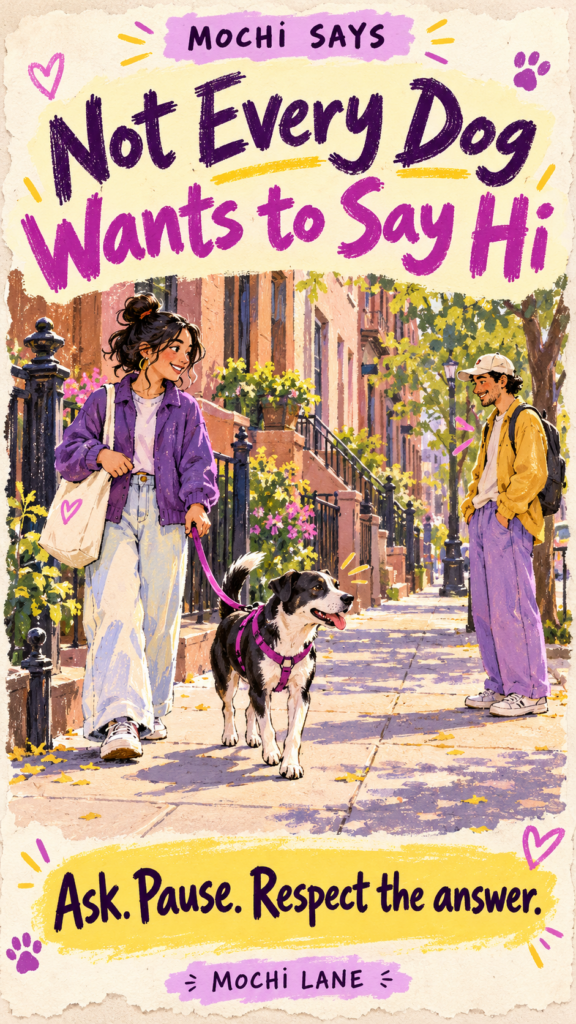
Not every dog
wants to say hi.
The Kindest Rule on a Crowded Sidewalk
A dog can be adorable, friendly and deeply loved—and still need personal space. Learning to ask before approaching and recognize a polite canine “no” makes city life safer and kinder for everyone.
A MOCHI SAYS READ · MOCHI LANE
City dogs share a lot: sidewalks, elevators, lobbies, parks and approximately four square feet of personal space during rush hour.
That closeness can create lovely moments. It can also make every walk feel like a public meet-and-greet—especially when a dog is cute enough to stop traffic.
But not every dog wants to say hello. 🐾
Some dogs are shy. Others are healing, training, working or simply tired. A dog may enjoy people at home but feel overwhelmed by strangers reaching toward them on a noisy sidewalk. Respecting that boundary is not rejection. It is good dog etiquette.
01Ask the person—and listen to the dog 🐶
Before touching an unfamiliar dog, ask their person for permission. The American Veterinary Medical Association and ASPCA both recommend asking first and allowing the dog space to approach rather than placing a hand directly in front of their face. American Veterinary Medical Association
Even after the human says yes, pause and look at the dog.
A relaxed dog may choose to come closer with a loose body. A dog who turns away, freezes, crouches, repeatedly licks their lips, flattens their ears or tries to move away may be asking for distance. A wagging tail alone does not always mean a dog is comfortable. ASPCA
The kind response is simple: give them room.
02Skip the surprise affection 💛
Many people show love by hugging, leaning over or patting the top of a dog’s head. To an unfamiliar dog, those gestures can feel intense.
If the dog and their person welcome interaction, stay calm and let the dog approach. Avoid crowding, grabbing or bringing your face close to theirs. A brief, gentle touch near the shoulder or chest may feel less intrusive than reaching over the head.
And if the dog walks away, the conversation is over. No hard feelings.
03Do not assume dogs should greet each other 🐕
Two dogs passing on leashes do not need to meet simply because they are dogs.
One may be recovering from surgery. Another may be learning to stay calm around other animals. A recently adopted dog may still be adjusting to traffic, strangers and the mysterious rolling suitcase that appears every morning.
Before allowing a greeting, ask the other handler. If either person declines—or either dog looks uncomfortable—create distance and keep moving.
Crossing the street is not rude. Sometimes it is excellent communication.
04Let people advocate without apologizing 🐾
Dog guardians should feel comfortable saying:
- “They need some space, thank you.”
- “We’re training right now.”
- “No greeting today.”
- “Please let us exit the elevator first.”
A leash sleeve, yellow ribbon or “do not pet” patch may provide additional context, but nobody should have to explain a dog’s private history to justify a boundary.
“No” is enough.
05Teach children that asking is part of loving dogs 💛
Children may be especially eager to greet a dog, so adults can model a simple routine:
- Stop at a respectful distance.
- Ask the dog’s person.
- Wait for the answer.
- Let the dog choose whether to approach.
- Accept “no” kindly.
The AVMA specifically recommends teaching children to ask permission before petting and allowing the dog to approach first. American Veterinary Medical Association
A child who learns to respect a dog’s space is not missing an opportunity. They are learning compassion.
City life asks dogs to navigate a world designed for humans. We can make that world gentler by replacing assumptions with one small habit:
Ask. Pause. Respect the answer. 🐾💛
Help Mochi Lane normalize considerate city-dog greetings. Share this guide, teach one young dog lover how to ask first and give every pup permission to enjoy their walk without becoming public property.